
Aggression from dogs against humans and to other dogs. Why aggressive behaviour happens and how to deal with it..
Aggression: I think it is prudent to point out that aggression is rarely cured by just training.
Training classes are fine for obedience, but not aggression. Aggression is the realm of the behaviourist.
Make sure you employ a behaviourist, that is well versed and an expert in this area of behaviour.
Remedial classes can be used, once the triggers and types of aggression are known, and when you have a workable program to follow.
Once you have worked through that program. Then depending on the aggression, a well run remedial class can help with desensitisation.
You will need a behaviourist rather than a trainer because of the complexity of the triggers involved in what may have caused the aggression in the first place.
Aggression can be related to fear, dominance, pain, territorial, diet, one incident reaction, illness. The list can be very long Many factors would have to be taken into account before setting a workable program to overcome the problems.
The first thing to work out is what was the potential trigger, for instance, is it fear, dominance, aversion, or territorial, Could it be hormonal, guarding, one incident reaction or is it genetic or a learned behaviour? Along with many other reasons for the behaviour. This article will help you diagnose the cause and what to do once you know why it happens.
Types of Aggression: As a behavioural concept inter-dog aggression is separate and very different from aggression to humans. When looking at aggression, it is prudent to consult your Vet, simply to rule out medical causes.
There are over 50 medical reasons for aggression. This is especially true if the aggression comes on suddenly and is out of character.
It is sometimes difficult for us mere humans to read the signals of dogs that are likely to or intend to attack us. We are not equipped to read the body language or subtle signs of our canine friends.
Dogs for instance with drooping ears like the Weimaraner, or dogs with tails that curl over the back such as Akita’s and Chows. These do not give the same signals as a Collie or an Alsatian, the classic erect tail and ears pulled back cannot be seen in some breeds.
Which is also the case with hairy or Spitz-type breeds. In these circumstances, we do not see the obvious signs like raised hackles or erect tails. The majority of attacks are to family members, neighbours or people the dog’s owner knows.
Because of the problems of overcrowding, more attacks are town or city-based rather than rural or agricultural areas. A sad fact of life is that often children are the victims. The incidence of facial reconstructive surgery in young children is predominantly dog bites.
The choice of dog also has a marked effect on whether dog aggression or bites may occur. The guarding breeds tend to guard, the herders tend to herd and the retrieving dogs predominantly retrieve. Therefore if a dog had been bred to guard we shouldn’t be overly surprised it does just that.
 Sudden Attacks: It is very unusual for a dog to suddenly attack for no apparent reason, ie out of the blue attacks,
These are almost unknown, except where medical reasons are the trigger.
We have all met the person who’s dog attacks your dog or nips your ankles and the plaintive cry is; “Oh he has never done that before”
I even had a lady owner locally her dog, a West Highland Terrorist, attacked my dogs on sight, who said exactly that.
Then the very next day it did it again and she uttered exactly the same words. Owners often go into denial over their dog’s behaviour.
Excusing Bad Behaviour: Owners can be guilty of excusing the aggressive Terrier, the nipping Collie or the growling miniature breed because they perceive this is acceptable behaviour for the breed.
This mindset normally means the dog had not been corrected when it was first observed, allowing the trait to become stronger and eventually very difficult to eradicate. The longer you leave aggression the stronger the trait will become until finally, it becomes extremely difficult to change this behaviour.
Fear-Based Aggression: I have found that the majority of aggression to be fear-based though we often categorise them as Predatory, Sexual, Territorial, Protective, and Nervous/Fear Aggression. If you suspect your dog is fear-based aggressive do not rush out and have it neutered. Neutering always heightens this aggression rather than curing it.
We have all heard the cry ” Oh just neuter it that will sort the problem out”. That statement has caused more dogs to be euthanised than almost any other comment and could not be further from the truth.
Neutering can help with male dogs that are fighting other intact male dogs (hormonal). It never helps with female dogs and generally makes it considerably worse, if the aggression is against both female and male dogs it is almost certainly fear-based. Therefore do not rush to have it neutered. Neutered is the generic term for spaying and castration
Read my articles on (1) The Dangers of Neutering. Do not listen to the armchair experts and most Vets who know nothing about behaviour and have a strong financial interest in neutering.
Having said all that it is rare indeed for the dog to have just one of the problems mentioned above, and the worse combination is dominant, nervous, and fear aggression linked together. Nearly all of these aggressions can be traced back to the first sixteen weeks of a dog’s life. Read (2) Critical Periods Puppies
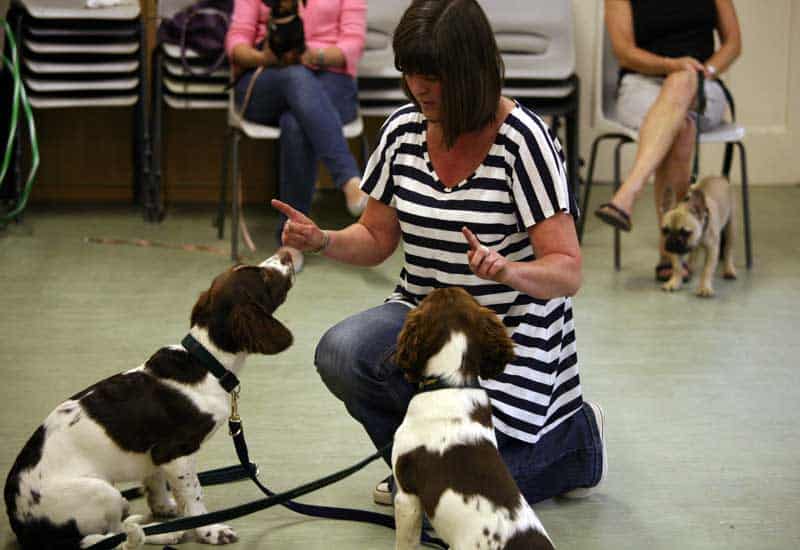
Early Socialisation: Dog aggression problems often have their roots mainly in the lack of contact with other dogs and people,
Early socialisation with other puppies is an absolute must. This should well before 16 weeks of age.
There are critical periods where puppies learn, 0-16 weeks in the most important.
Puppies do not learn to communicate with other dogs from adult dogs they learn from pups of a similar age.
Pups should be handled from birth to 12 weeks by at least a hundred different people including children and adults.
The Human Socialisation period is 0 to 12 weeks. The Canine Socialisation period is 0 to 16 weeks Taking responsibility and controlling games should give the owner control over each dog and help both in the short and long term this type of unacceptable behaviour
Intact non-neutered males are more likely to exhibit dominance aggression (but only against other intact dogs) than neutered males or spayed females. It is more likely that this is controlled by androgen since females who show aggression before puberty and who are spayed become more aggressive.
Fear aggression and protective aggression are the most common aggression cases I have to treat. But be aware that in the main it is fear aggression that s the most common.
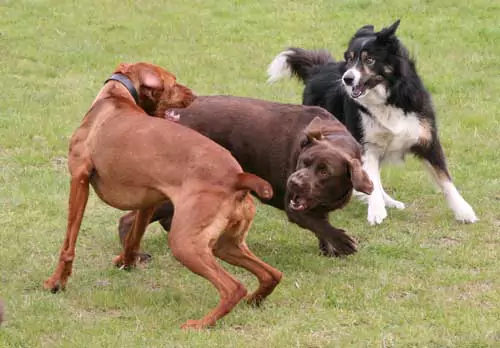
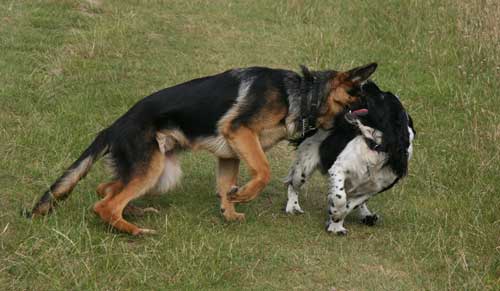
Interdog Aggression in The Home: This Is generally social in context and can occur between dogs within the same house, and is rarely hormone-driven, although it generally though not always starts at social maturity (12 to 24 months). The dog is challenged by a stare or a bump or body block, and then each dog behaves in reaction, to what the other dog did. If this is not treated early it will escalate until it becomes an all-out war.
These dogs can end up hating each other, even though they have been the best of friends or even siblings just weeks before. I have seen almost military operations performed in some households, to make sure the dogs never have to meet.
When it has got to that stage, then unless you get someone in who understands how to work with these types of aggressive behaviours. (I have done hundreds of these cases) Then you will end up having to euthanise or try and re-home one of them. The key is early intervention. See my article:(4) Sibling or Interdog Rivalry
If they start to fight just because they have seen each other, then it is generally caused by fear and is responding to protective aggression, (and the classic lead aggression in some cases). A characteristic of inter-dog aggression is that aggressive intentions are rarely displayed to other animals. The dog may live amicably with cats, horses, and other animals or pets.
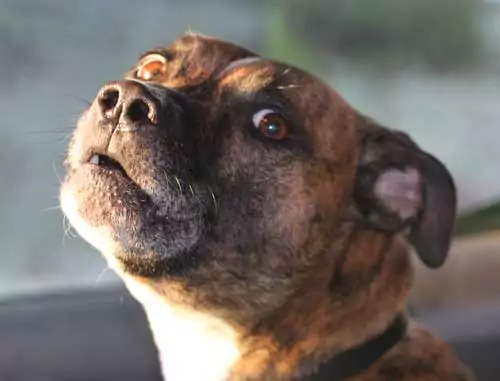
Protective Aggression: This can be stimulated by sudden movements. Someone in the room suddenly gets up. That action can trigger the aggressive response.
Frequently the dog inhibits the behaviour in the absence of its owners or the person, child or dog it feels the need to protect (no owner to protect).
It can also be non-reactive in strange places, (dog shows for instance), or anywhere there are lots of dogs or people.
In these circumstances, they cannot identify a specific threat, because they are flooded with potential threats. And the behaviour, therefore, does not occur.
Sometimes dogs protect people or animals they consider vulnerable. These dogs have never shown aggression until a puppy or a new baby is introduced into the household. They may be fine indoors but then become very protective outdoors from strangers or other dogs or vice versa.
Male or Female dogs can display this type of aggression. It normally starts around about social and mental maturity that would depend on the breed but as an average that would be between 1 and 3 years of age. The larger of the breeds the older it will be before this type of behaviour occurs. Puppies rarely show this trend.
Hormonal Aggression. Occurs overwhelmingly in males (90% of cases), First becomes obvious at social maturity (12 to 24 months), or later if neutered before maturity. worsens with punishment and may run in family lines.
This type of aggression is the type which is looked for at the 8-week puppy test. If can be identified at that age, Early intervention is required to save the dog, but not all dogs with dominant aggression can be identified at 8 weeks.
Most of us have dogs who to some extent display signs of territorial aggression: our dogs bark at someone at the door, protect the car, bark as people pass on the pavement. All social animals exhibit some protective aggression.
This behaviour is increased by fences; the dog is able to continuously “patrol” and protect. The behaviour can be made worse if the dog is enclosed in say an electric fence or chained up.
It can also be made worse if “door greeting” abnormalities are tolerated: the owner greets someone at the door with the dog held back whilst straining on the collar whilst possibly barking and growling.
Dominance aggression, in contrast to protective aggression, there is more growling, snarling, biting, and staring. Barking is consid ered a sign of protective aggression — think about barking dogs as you pass a garden.
In all the cases where I have worked with reactive, aggressive and fear-based dogs I have always started by using the Jingler. It is a training tool that is incredibly effective. You will have heard of a clicker? Clicker training is highly effective though |I never use a clicker I use the word good in its place.it is far easier. If you imagine that the Jingler is the opposite of a clicker.
Whilst the clicker tells your dog when it has done something right, The Jingler indicates when it has done something wrong. It also tells the dogs you are a controller of resources and this is the key to controlling unwanted behaviour in dogs Read (5) The Jingler Further Information
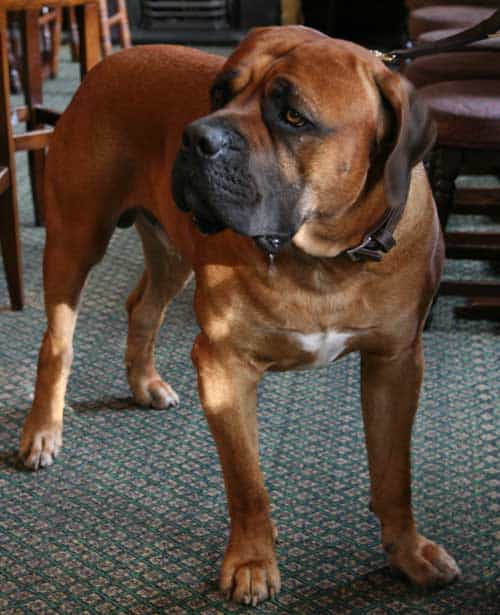
Dominance Aggression: This is considered a concept of control, unlike possession of an object (food or object aggression) or challenge (will the dog get off the sofa or growl?).
Dominance aggression is more common among men owners who like the concept of “big, tough dogs” and so some breeds might be more likely to be diagnosed with this problem.
But the worst dominant aggressive dogs I have dealt with, have normally been Toy Poodles, Chihuahua’s and Shih Tzus.
Their Behaviour is more likely to be seen as innocent and owner tolerant.
There are some 15 things people do to exacerbate dominance aggression — as simple as staring at the dog or pushing on their rump, leaning over them, making a lead correction.
There are also some 20 or so signs that the dog intends to become dominant aggressive.
That could be as innocent as standing on your feet, leaning against you, talking back, standing in front of you in the doorway, jumping in your lap.
These signs are often tolerated in smaller dogs. I do not understand why? Though it may not do as much damage as say a Mastiff, that should not excuse from being aggressive.
Dogs with dominance aggression are categorised in behaviour as those who think they are Alpha’s therefore able to control people and get things their own way — a bad, prognosis usually. And then there are those dogs where all the signs were there and we allowed them to get away with it.
First, although other aggressive behaviour is not a predictor for dominance aggression, dominance aggression is about control, and the dog generally has other forms of aggression also.
Strangely enough, a common trait is that dominant dogs can also be very sensitive, they can also have fearful and anxious behaviour. That could almost class them as schizophrenic.
Second, When the dog has escalated through several signs of dominance aggression, standing on people, sitting in laps, and it’s allowed by the owner.
Then the dog thinks it’s in charge — like when the teenager starts to talk back to test boundaries. This class of dogs will alter its Behaviour to the individual.
The dog may not behave aggressively with an experienced trainer (the trainer is in charge), or when it’s eating it may not bark at people passing by.
The dog can interrupt and inhibit aggressive behaviour but chooses its time when not to react. This actually is the easiest dog to work with since the dog is capable of taking cues from context and behaving appropriately. However, it would be extremely difficult to determine the exact genetics for this behaviour, since the development of the behaviour depends not only on the genes but also the dog/owner situation.
If the dog was genetically predisposed but owned by a good trainer and discouraged at an early age from barking at say the door, it may not exhibit the trait ever again. On the other hand, a dog who may genetically be less predisposed but encouraged to exhibit the behaviour, it then can become a major problem.
© Stan Rawlinson 2001
Last updated 2020
Stan Rawlinson is an expert witness under the 1991 Dangerous dogs Act 1991. He acts in cases that are deemed to be a Banned Breed or Dogs that have been charged with being dangerously out of control.
He has been accepted by the UK Law Courts as a credible expert witness, and an expert temperament assessor and produces professional reports for the courts and clients. However, Stan retired from one to ones 4 years ago
(1) Neutering
(3) Different Types Of Aggression